Mesh function Application Object
A Mesh_function is a Maths_function that:
has a domain that consists of a table of real tuple spaces;
The table is a one dimensional array for an unstructured mesh, but can be a
rectangualar array of any dimension for a structured mesh.
The real tuples spaces can have different dimensions, if the mesh contains
cells of different dimension.
The real tuple spaces can have different bounds, if the mesh contains cells
of different shape, such as tetrahedrons and hexahedrons.
has a set of control values, such that the function within each cell is
determined by a subset of the control values and the basis for that cell; and
The assignment of control values to cells is determined by the topology of
the mesh. A control value is usually, but not necessarily, the value of the
function at a position within the mesh.
interpolates or extrapolates separately within each cell from the
control values assigned to that cell.
EXAMPLE - The Mesh_function
'my_function_from_gauss_points' is defined with respect to the mesh shown in
Figure 1. This function has 16 control values. The function uses bi-linear
interpolation/extrapolation within each cell from the control values that are
at Gauss points within the cell.
Figure 1: Mesh function with interpolation from Gauss
points 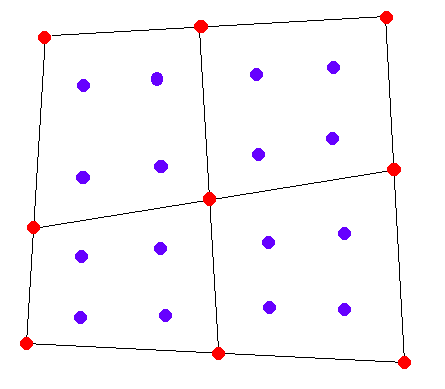
EXAMPLE - The Mesh_function 'my_function_from_corners' is
defined with respect to the mesh shown in Figure 2. This function has 9 control
values. The function uses bi-linear interpolation/extrapolation within each
cell from the control values that are at corners of the cell.
Figure 2: Mesh function with interpolation from corner
vertices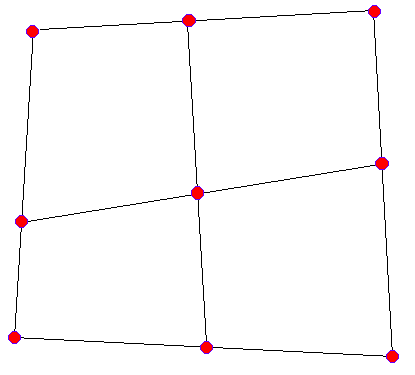
EXPRESS specification:
*)
ENTITY Mesh_function
  SUBTYPE OF (Maths_function);
  basis :  OPTIONAL LIST[1,?] OF Mesh_function_basis;
  control_values :  Table;
  mesh :  Mesh;
  uniform_basis :  OPTIONAL BOOLEAN;
  values_at_vertices :  BOOLEAN;
  WHERE
    necessary_basis :  values_at_vertices OR EXISTS (basis);
    uniform_specified :  EXISTS (basis) = EXISTS (uniform_basis);
    one_basis_if_uniform :  IF EXISTS (basis) AND
                               EXISTS (uniform_basis) THEN
                              IF uniform_basis THEN
                                SIZEOF (basis) = 1;
                              ELSE
                                TRUE;
                              ENDIF;
                            ELSE
                              TRUE;
                            ENDIF;
END_ENTITY;
(*
Attribute definitions:
basis: the Mesh_function_basis that specifies the method of
interpolation or extrapolation to be used within each cell of the mesh.
If uniform_basis is true, then a single
Mesh_function_basis is specified for use within each cell. If
uniform_basis is false, then a Mesh_function_basis is specified
separately for each cell of the mesh.
control_values: the Table that contains the control values at
the vertices of the cells of the mesh or at the discretisation points within
each cell. The Table shall be a structured according to the following
rule.
The Table is a function with:
- domain:
- an integer tuple space that identifies the discretisation points of the
Mesh_function;
- range:
- the range of the Mesh_function.
The components of the integer tuple space domain are shown in Table 1.
Table 1: Domain of the control values Table for a
Mesh_function
| unstructured mesh |
values at vertices |
i
where:
- i is the position in the vertex array specified for the unstructured
mesh.
|
| unstructured mesh |
discretisation points for each cell |
j1, j2,
...jn, i
where:
- j1, j2, ...jn is the
position in the pattern of discretisation points, for the cell basis;
- i is the position in the cell array specified for the unstructured
mesh.
|
| structured mesh |
values at vertices |
i1, i2,
...in
where:
- i1, i2, ...in is the
position of the vertex in the structured mesh.
|
| structured mesh |
discretisation points for each cell |
j1, j2,
...jn, i1, i2,
...in
where:
- j1, j2, ...jn is the position in
the pattern of discretisation points, for the cell basis;
- i1, i2, ...in is the
position of the vertex in the structured mesh.
|
mesh: the Mesh for the Mesh_function.
uniform_basis: a flag that indicate whether or not the
Mesh_function a uniform basis, as follows:
- if uniform_basis is true, then each cell of the mesh has the same
Mesh_function_basis;
- if uniform_basis is false, then a Mesh_function_basis is
specified separately for each cell of the mesh.
values_at_vertices: a flag that indicate whether or not the control
values are specified for the vertices or the cells of Mesh, as follows:
- if values_at_vertices is true, then the control values are specified
for the vertices of the Mesh;
- if values_at_vertices is false, then the control values are
specified for a separate pattern of discretisation points for each cell of the
Mesh.
Formal propositions:
necessary_basis: if values_at_vertices is false, then a
basis shall be supplied.
NOTE - If the control values are specified for a separate
pattern of discretisation points for each cell, then the basis attribute
is required to specify the pattern.
uniform_specified: a uniform_basis flag shall be supplied if,
and only if, a basis is supplied.
one_basis_if_uniform: the length of the basis list shall be 1, if the
a uniform_basis flag is true.
NOTE - each cell has the same basis if the
uniform_basis flag is true. Therefore, only one basis shall be
supplied.